For organizations, centers, and care teams
A session is a point in time. Fluence reveals the trajectory.
Longitudinal, person-specific continuity for teams supporting people through trauma, crisis, and psychological change.
Fluence gives mental-health teams visibility between encounters through brief patient reports, personal baselines, and focused pre-session context.
Not a diagnosis · Not a treatment recommendation · Not a replacement for a professional · Not an emergency service
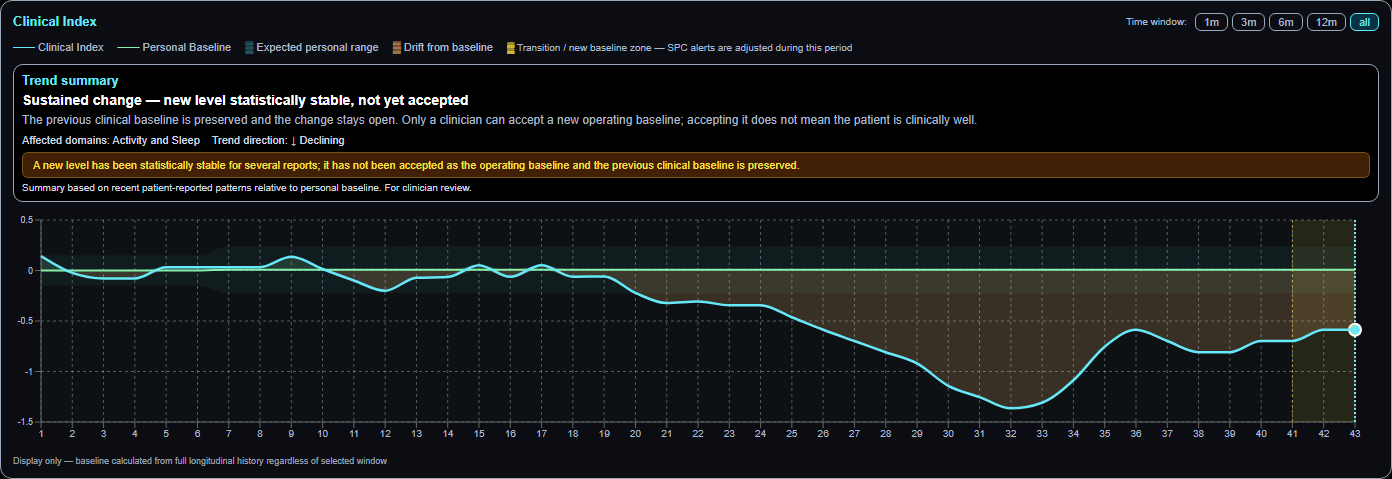
Every screen on this page is a real Fluence screen, shown with synthetic data only.
The problem
A session is a point in time. The process continues between sessions.
- Teams see each person for a limited time — an hour a week, sometimes less.
- Meaningful changes usually happen in between: sleep, stress, relationships, routine.
- Important context gets forgotten, understated, or reaches the conversation too late.
- A single report describes a moment. Teams supporting a process need continuity.
Fluence does not replace the session. It connects the sessions.
Why Fluence exists
From detecting change in complex systems to seeing change in a person over time
For about 30 years I worked on imaging systems, machine vision, AI-based classification, real-time object detection, and process monitoring. At its core, that work is one discipline: finding the meaningful signal inside a complex, noisy system, and telling ordinary fluctuation apart from change that persists.
Fluence applies the same systems thinking to longitudinal mental-health follow-up — not to replace professional judgment, but to give care teams a continuous view of each person, measured against themselves.
Yoram Biton · Founder, Fluence
How it works
Three steps, without changing how your team works
-
The person reports
A short check-in, free text, or a voice note — whenever it suits them. A few fixed questions keep reports comparable over time.
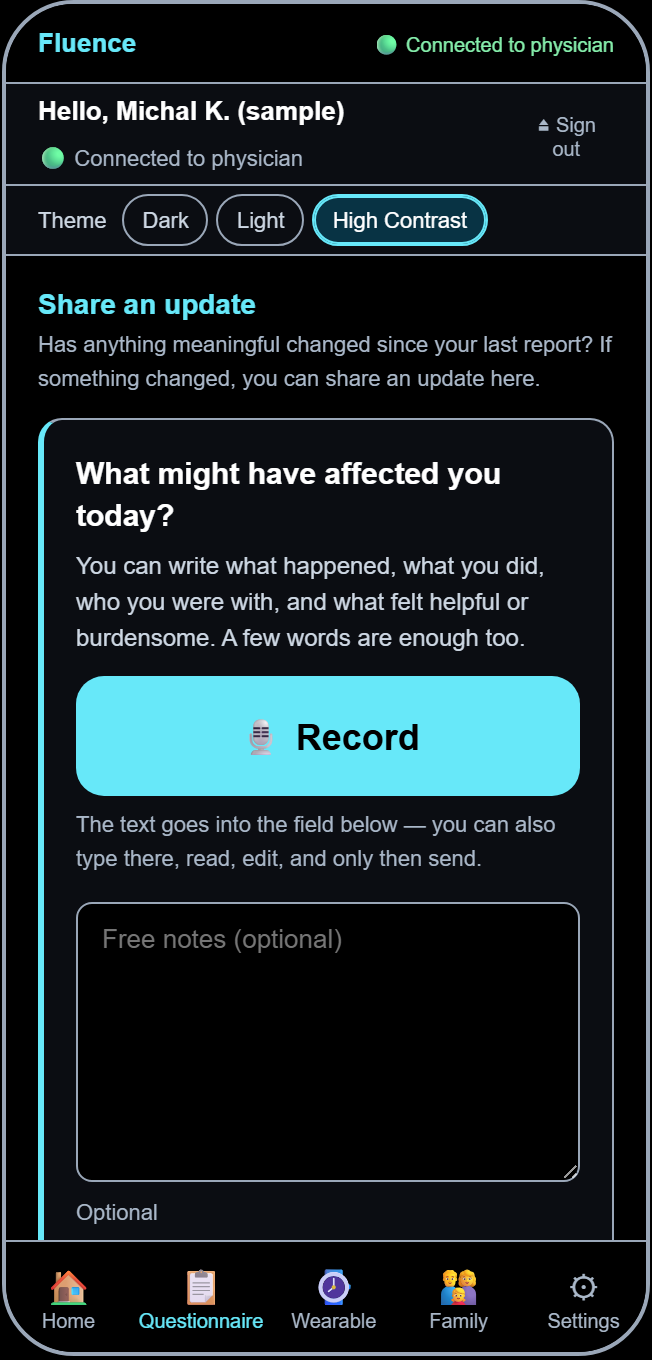
Patient app: a brief update, written or spoken.Reporting takes a minute or two, so continuity holds even through difficult periods. -
Fluence learns the personal baseline
Each person is compared with their own pattern, not with an average person. Fluence distinguishes ordinary fluctuation from change that persists, and flags it conservatively.
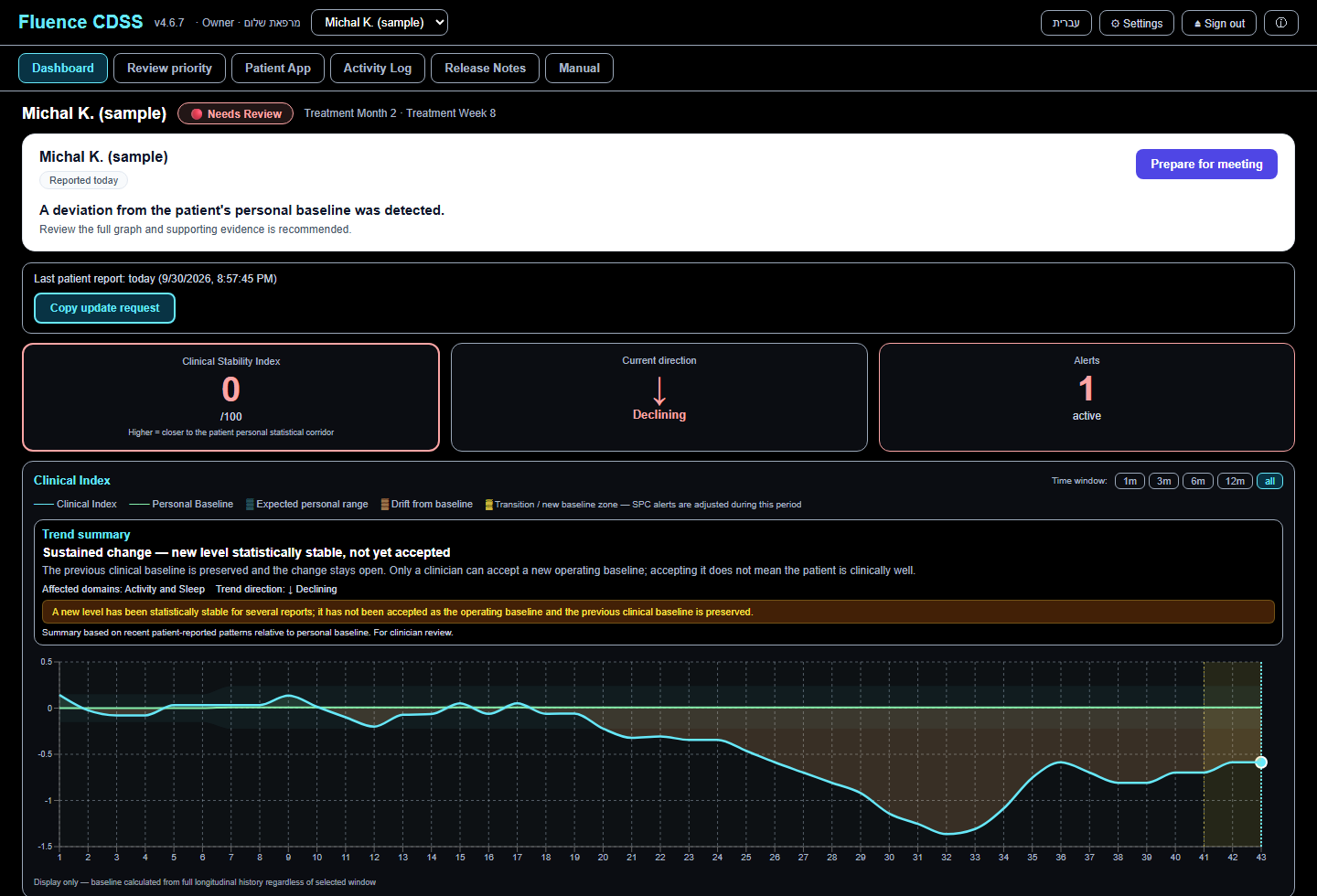
Clinical dashboard: status against the personal baseline, direction, and active alerts.At a glance: whether this person shows a persistent change, and in which direction. -
The team receives useful context
Before the session, the authorized professional sees a focused view: what changed, when, and what the person wrote in their own words.
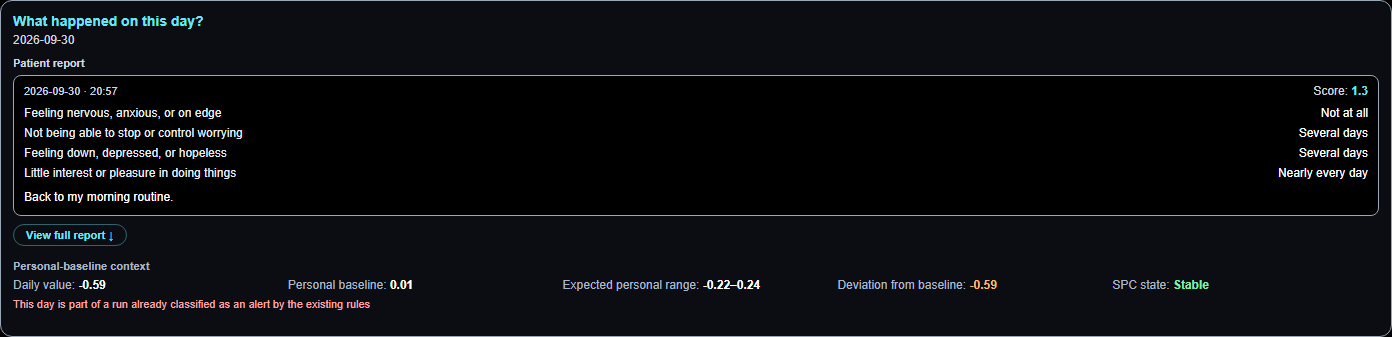
Day view: report answers, the person's own words, and their position against baseline.Sessions start from what actually happened between encounters — not only from what is remembered.
Organizational value
What changes for your team and organization
- Better continuity between encounters.
- More focused preparation before each session.
- Less reliance on memory alone.
- A clearer view of individual change over time.
- A structured way to preserve each person's experience, in their own words.
- Minimal additional burden on the clinical team.
- Clear clinical ownership — decisions stay with professionals.
What your organization receives
A 90-day organizational pilot
A focused pilot with a clear owner and a decision point at the end.
- One participating organization or center.
- One defined patient population.
- One clinical or program owner.
- One or two participating professionals.
- Platform setup.
- Onboarding and training.
- A patient reporting workflow.
- Personal baselines and change signals.
- Pre-session summaries.
- An end-of-pilot review.
- A decision to continue, adjust, or stop.
The pilot framework and engagement terms will be agreed together during a fit conversation, based on your organization's needs and the scope of activity.
Explore an organizational pilot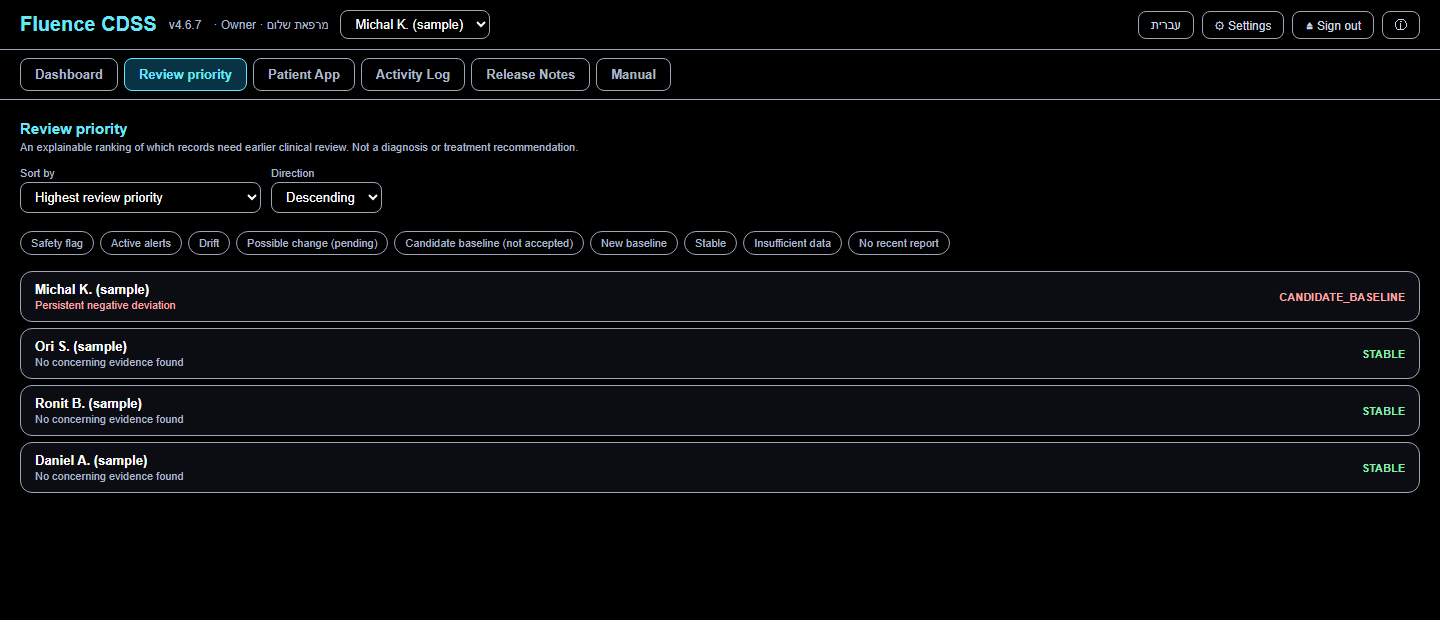
How success is evaluated
What the 90 days assess
- Reporting continuity.
- Patient participation.
- Usefulness of the change signals detected.
- Value of pre-session summaries.
- Fit with your organization's workflow.
- Feedback from professionals and participants.
- Implementation burden.
The pilot evaluates usability, workflow fit, and the clinical relevance of the information. On its own, it does not demonstrate improved treatment outcomes.
Boundaries and responsibility
What Fluence does — and does not do
- Fluence does not diagnose.
- Fluence does not recommend treatment.
- Fluence does not replace professional judgment.
- Fluence is not an emergency service, and information is not monitored in real time.
- The participating organization remains responsible for clinical governance, escalation, consent, and decisions.
- Access is role-based: each professional sees only the patients assigned to them, and staff sign-in is protected by a second verification step.
This page and its contact form neither collect nor display any patient information.
Next step
Explore an organizational pilot
A 20-minute fit conversation: your population, your owner, and what a pilot would look like for you.